Stage Raw Review 2025
Joel Beers
Hold on to your hats, your handbags and your latest plush prize wrestled from a claw machine marathon, because you’re about to read the most enthusiastic endorsement a theater critic can give: I’m buying tickets the next time that Long Beach Ballet stages The Nutcracker.
This is, hands down — and ballet flats up — the most over-the-top, jaw-dropping, stage-devouring production I’ve ever seen, not just of The Nutcracker but of anything.
I don’t know how Nutcracker purists (if there is any such thing) or diehard aficionados view this David Wilcox–conceived and directed spectacle which, if it doesn’t stand alone, stands in rarefied company. According to the official press release, it has dazzled more than 400,000 people in Long Beach and over a million around the world since its debut 43 years ago.
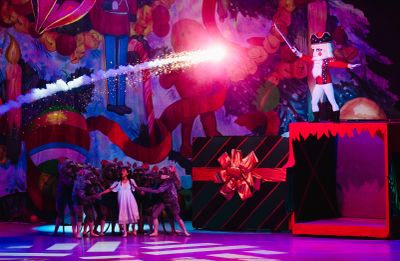
Nor do I know how many other productions boast an aerial sleigh, a live horse onstage, pyrotechnic-spewing cannons, stage illusions that make cast members vanish and reappear, some 200 dancers, marching soldiers and mice, Christmas trees that start enormous and grow even larger, and a something called Mother Ginger so vast in her hoop-skirt costume that she seems to swallow the stage, with some things called Polichinelles popping out from underneath.
I’m not sure what these are because my frame of reference for ballet and The Nutcracker is limited, to say the least: a vaguely remembered Orange County Performing Arts Center production from decades ago, plus the score’s endless reinventions in commercials and films like Fantasia and Home Alone, and as the cinematic shorthand for motion, mischief and pure holiday chaos. Hell, even my Tchaikovsky touchstone is less classical music than the shout-out in the Beatles cover of Chuck Berry’s Roll Over Beethoven.
But I do know this: this production, both for its big and bold spectacle and the entrancing movement of human bodies onstage in tandem with a full symphony orchestra (which, again according to the press release, is one of the rare ensembles to include two harps, making this one of the few to sound like the composer intended) is joyful, exuberant, beautiful and astonishing.
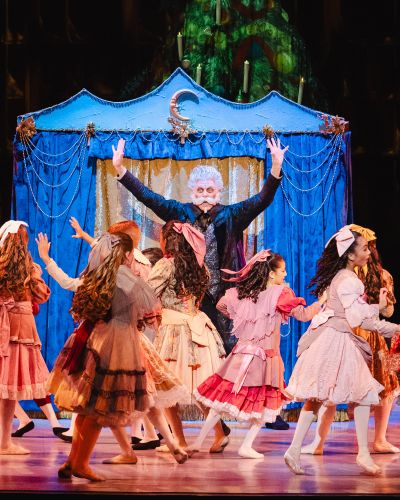
The big set pieces and flourishes, courtesy of former Disney designers Elliot Hessayon and Scott Schaffer (scenery), Adrian Clark (costumes), and Franz Harary (illusions and special effects), generate a lot of the buzz, and the seemingly endless battalion of child performers supplies the mass, but the heart of this production lies in in the solo performances. It’s the grace and fluidity of the featured dances that stay with you.
Even choosing performers who stand out can be tricky. For instance, this past weekend, Derek Drilon of the Joffrey Ballet performed as the Prince along with Megan Wilcox of SemperOper Ballett and California Ballet as the Sugar Plum Fairy — but next weekend those roles will be performed by Vitor Luiz, former principal dancer of the San Francisco Ballet, and Tara Ghassemieh, a renowned Iranian-American principal ballerina..
Suffice it to say that all the featured dancers are extraordinarily talented, making what must be incredibly difficult physical feats and intense mental concentration seem effortless.
But there is one more element to this production that isn’t seen onstage or heard emanating from the pit — and it might be the most important element of all: the undeniable electricity in the crowd and its intense attachment to what unfolds onstage. There wasn’t an empty seat in the 3,000-capacity Terrace Theater at the opening Sunday matinee. Sellouts in a theater are always special, but many it can seem as if people are there because they’re supposed to be. There’s a big star onstage, or the play is an event, for whatever reason.
While there are ballet stars on this stage and this Nutcracker is an event, but the enthusiasm and love for this production among the audience is natural and infectious. Yes, it’s theatrical and filled with spectacle, but it’s also weirdly intimate. It’s like a huge extended holiday gathering one where, for a couple of hours, the theater truly feels like home.
LA Excites Review 2024
Imaan Jalali
“Tradition” and “mainstay” often get thrown around facilely, but Long Beach Ballet’s The Nutcracker truly encapsulates the intended meaning of such words. Remarkably now in its 42nd year, the production is as captivating as it was during its inaugural run — and that’s saying something for a show that is played in practically every city during the holidays.
Artistic Director David Wilcox has crafted an enduring ballet that does more than pay homage to Pyotr Ilyich Tchaikovsky’s score and the original story it’s based on — E.T.A. Hoffman’s 1816 yarn about The Nutcracker and the Mouse King; this annual offering, which boasts a cast of 200-plus, serves as the ultimate presentation at the Terrace Theater by which other Nutcracker productions should be measured against.
One-million people worldwide, including 400,000 in Long Beach alone, have experienced Wilcox’s vision which combines the hearty substance of an unfolding narrative with visually appealing pomp and circumstance. To this aim, scenic designers Elliot Hessayon, Scott Shaffer, and Rex Heuschkel have played a significant role. Sets feature a snowcapped roof, the stately Stahlbaum home, an enormous Christmas tree with giant-sized gift boxes, stars and snowflakes (in the Pine Forest), grand columns (in the Land of Sweets), ethereal clouds, and more.
The immersion that comes of this imagery is augmented by Adrian Clark, Donna Dickens, Ann de Farra, Hilde Byrne, and Cheryl Cartwright’s majestically balletic costumes and suitable character garb. Putting the visuals over the top are Jared Sayeg’s sumptuous lighting and the pyrotechnics which strike awe in the attendees specifically in Act I with spectacular cannon blasts and a waterfall of gold sparks as a sleigh is pulled into the sky by a prop Pegasus (a real-life horse makes an appearance in Act II).
Amplifying the seeable is, undoubtedly, the timeless songs of The Nutcracker Suite, actualized to perfection by the Dr. Roger Hickman-conducted symphony orchestra — featuring not one but two harpists — which takes this production to the next level as many Nutcrackers use prerecorded music. The Spanish, Arabian, Chinese, and Russian numbers have never sounded so lush and full of life; the same can be said for the “Waltz of the Snowflakes,” “Dance of the Reed Flutes,” “Waltz of the Flowers,” and, of course, the headline attraction, the “Dance of the Sugar Plum Fairy.” The instruments resound with an amalgam of tranquility and fervor, leading the audience on a ride that can best be described as entrancing.
The whimsical, early 19th century premise starts off like any other Christmas Eve. Herr Stahlbaum is hosting the festivities with his wife at their German residence, celebrating the holiday with their children and friends. Soon, the Stahlbaum’s oldest, Clara, is spotlighted as her uncle, Herr Drosselmeyer, a toy inventor and clockmaker, pays her a visit. Drosselmeyer brings over a collection of dolls, including a wooden Nutcracker, which is accidentally broken by Clara’s brother, Fritz. Nonetheless, when the clock strikes midnight, the Nutcracker figurine, since fixed by Drosselmeyer, becomes animated and, alongside his gingerbread soldiers, becomes engaged in a battle against the Mouse King and his mouse army. Clara becomes entangled in this duel, which sees a princely outcome for the Nutcracker. He then leads Clara through the magical Pine Forest before introducing her to the Sugar Plum Fairy in the Land of Sweets where Clara, watching adoringly from the Fairy’s throne, takes in disparate dances celebrating international confections.
The scenes flow without a hitch and the tenor of the production remains lighthearted despite some of the conflicts encountered; nevertheless, there is an investment that persists throughout because it not only appeals to children but the childlike imaginations still living inside many adults.
Given that the Long Beach Ballet is the company being highlighted, the dancing is, of course, top-notch. Each en pointe moment, tendu, battement, pirouette, relevé, jeté, and more, are bound by an artful grace and not without a purpose. With Terri Lewis providing additional choreography alongside Wilcox, nothing is wasted in terms of movement, giving the impression of a free-flowing depiction via physical form, so abundant with humanity that the absence of words feels as natural as a play with spoken lines or a musical with sung lyrics.
There is astonishingly not a weak link among the age-varied performers who are as young as three or four. The little prodigies demonstrate remarkable attention to detail, and the adults underscore the extent to which practice makes perfect.
Standouts who are exceptional at communicating with their facial expressions include the preternaturally talented Angela Carter as Clara, the poised Mariano Sanz as the distinguished Herr Stahlbaum, the charismatic Ben Majors as the mustachioed and sprightly Drosselmeyer, Ken Datugan as the sympathetic chimney sweep, the charming Michelle Terry as the towering Mother Ginger, Stephanie Boggs as the zany Maid as well as Charlee Del Pilar and Damian Kelly as the dynamically heartwarming duo of Jesters.
Among the dancers, Tate Lee soars as the Nutcracker Prince during solos and particularly in his show-stopping Grand Pas de Deux with the Sugarplum Fairy’s Megan Wilcox — an exquisite expert on body control. Snow King Jameson Keating, who makes multiple appearances as a kinetic force to be reckoned with, dazzles on stage with Snow Queen Maeve Callahan and, later, the elegant Kaitlyn Pong in the Spanish Dance. David Block earns laughs as the irreverent Mouse King before partnering with the masterful Ellen Bigelow for the Arabian Dance and then evoking hearty cheers with Hector Garcia and Benjohn Magcalas for the Russian Dance. Magcalas, Damian Kelly, and Bianca Gorbenko are immediate audience favorites as Drosselmeyer’s wound-up and vivified dolls. Nikki Boggs and Xiaolong Li are terrifically light-footed in the Chinese Dance, and, last but not least, the effortlessly agile Lizzy Stone is an exemplary Dewdrop Fairy.
Some fairy tales might be forgotten, but The Nutcracker never will be as it continually reminds audiences of its staying power every holiday season. Certainly, it stands to reason that not every production is equal in terms of what it promises versus what it delivers to audiences; however, as the last four decades have proven, David Wilcox’s Nutcracker not only meets expectations, it exceeds them. Ideally, The Nutcracker should blend the comforting warmth of the holidays with an enlivening fantasy that examines the possibilities of where real life meets the gilded pages of Hoffman’s story to the tune of Tchaikovsky’s indelible compositions. In a nutshell, this Nutcracker does all that and more.